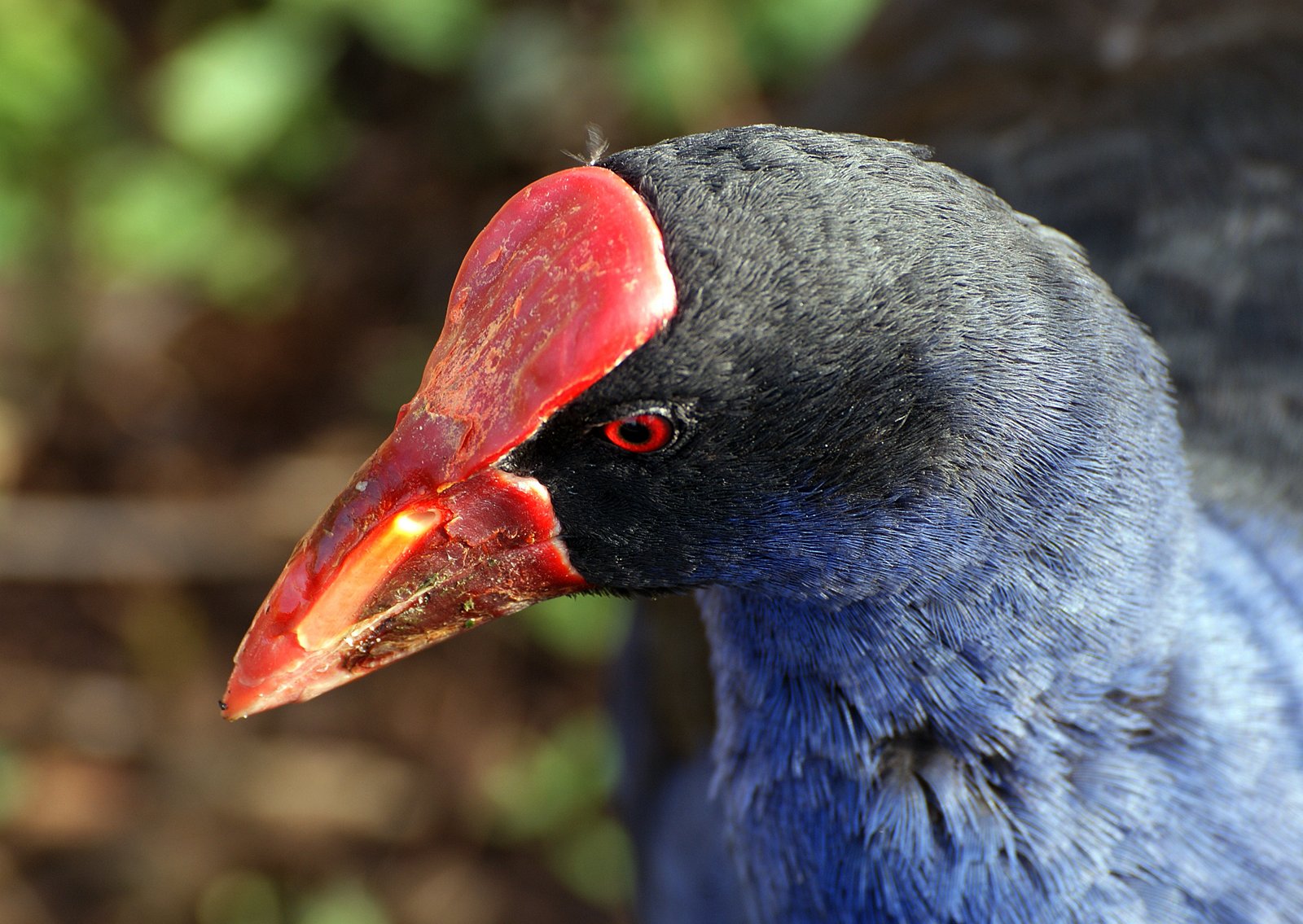
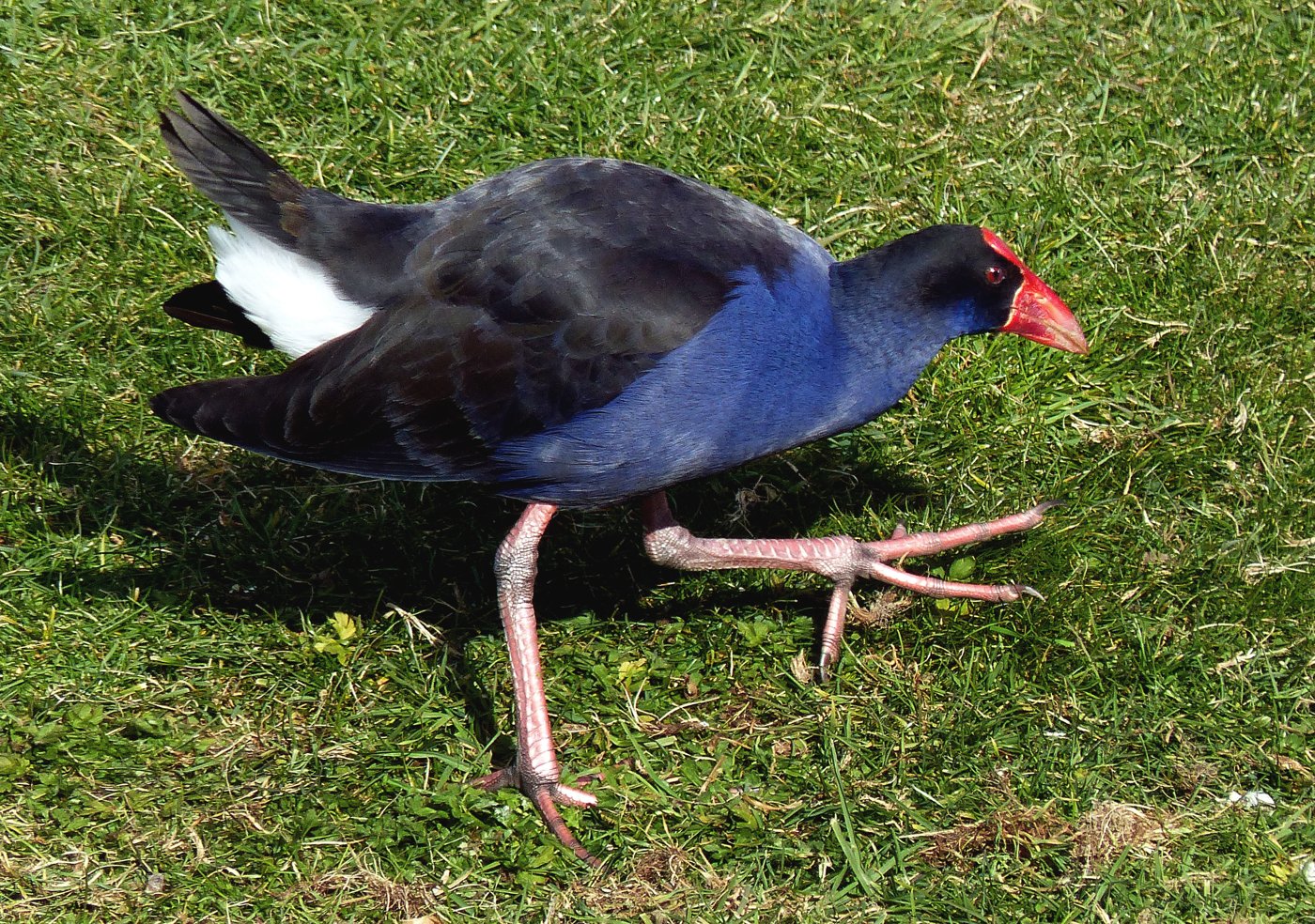
At the edge of a paddock or wetland, a pūkeko can look as though it is taking each step under serious consideration. The long toes, red bill and blue-violet breast make it instantly recognisable. Watch for a little longer and the familiar outline resolves into a working animal, searching, handling food and keeping track of other birds.
Those feet do more than carry it across the ground. New Zealand Birds Online describes pūkeko holding plant material in a foot while using the bill to work on it. A feature that looks exaggerated in a photograph becomes precise in use. The next time one pauses to feed, its feet may be more revealing than its face.
The white that flashes beneath the raised tail is also real plumage, not a missing patch in an otherwise blue bird. It is especially noticeable as a bird moves away. Along with the dark back and red frontal shield above the bill, it helps turn a passing glimpse into a confident identification.
Pūkeko are native to New Zealand, but not endemic: their species also occurs elsewhere. They should not be confused with the much rarer takahē. Pūkeko can fly, even though running or retreating into cover may be their first response to disturbance. Familiarity should make us better observers, rather than encourage assumptions from a cartoon silhouette.
A household with more than two parents
One of the bird’s least visible features is its social organisation. In some populations, several breeding adults share a territory and a nest. More than one female may lay there, and members of the group help raise the young. A group beside a road is therefore not necessarily a collection of unrelated birds feeding in the same convenient place.
This cooperative care complicates the simple picture of one pair and its chicks. The nest is part of a social arrangement, with shared labour and competing interests. Seeing an adult near a chick does not tell an observer exactly which relationship they are watching; a few minutes of observation cannot reveal the whole family structure.
Cooperation does not make the birds universally gentle. Groups defend space, and interactions with neighbouring birds can be forceful. Shared care and territorial conflict belong to the same life. There is no need to decide whether pūkeko are admirable or badly behaved before finding their behaviour interesting.
A respectful way to watch is to stay on the path and let the group’s movements continue without you. If a bird repeatedly moves away or interrupts feeding to monitor your approach, a closer photograph has started to cost it something. Step back and use the distance as an opportunity to watch the group rather than a single face.
Adaptable does not mean harmless—or secure
DOC describes a mainly plant-based diet with animal food also taken, including invertebrates and occasionally eggs or small animals. That versatility helps explain why pūkeko can succeed in modified places. It also explains why a gardener, a farmer and someone photographing a wetland may not tell the same story about the same bird.
It is tempting to smooth away those conflicts because the bird is charismatic. A better account allows them to remain visible. Native wildlife can damage a planting or prey on another animal without ceasing to be native wildlife. Understanding the context is more useful than forcing every species into the role of hero or villain.
Pūkeko have adapted to pasture as well as wetlands. Their presence in an altered landscape does not prove that all the species once living there have adapted equally well. A conspicuous survivor can draw attention away from the quieter absences: a place may still have birds while having lost much of its original ecological variety.
This matters in a country that has lost around nine-tenths of its historic wetland extent. Wetlands are more than a backdrop for bird photographs: they provide habitat and help slow and filter water. Seeing plentiful pūkeko beside a drain is not evidence that the work of protecting the surrounding wetland is finished.
Being a better neighbour
The most useful response is often to make space. Keep dogs under control, respect nesting areas and avoid drawing birds toward roads with food. A bird that seems comfortable around people still needs to forage and move on its own terms. Habituation is not the same thing as permission to approach without limit.
If a group appears to be causing damage, begin by understanding the attractant and seeking local advice on appropriate protection for the site. Do not assume that a bird’s abundance makes any intervention acceptable. The aim is to solve a particular conflict without turning an entire species into the problem.
Repeated visits are more rewarding than one spectacular encounter. Notice which edges the birds use, where they find cover and how their activity changes with weather or young chicks. You do not need to attach a grand conclusion to every observation. Learning a place often begins by noticing that yesterday and today are not quite the same.
That is why a pūkeko belongs on a site about everyday New Zealand. It is distinctive without being distant, familiar without being simple. Its oversized feet invite a second look; the second look reveals relationships, adaptation and the consequences of how we use land. Affection becomes more interesting when it grows into attention.